Documentation is a critical bridge between your product and its users, but keeping it synchronized with your code is a complex and often messy process. Choosing the right documentation platform can significantly impact how well you manage this challenge.
The difference comes down to scope: whether you want simple page hosting or a unified pipeline that generates SDKs and keeps your documentation code snippets in sync with your SDK code. To help you navigate these architectural choices, this comparison breaks down the specific trade-offs between Fern and Mintlify.
TLDR:
- Fern generates SDKs and API reference docs from your API spec
- Mintlify renders static documentation but requires separate vendors for SDKs
- Fern offers self-hosted deployment options that meet SOC 2 and HIPAA compliance requirements
- Fern offers role-based access control to gate content by user tier or audience
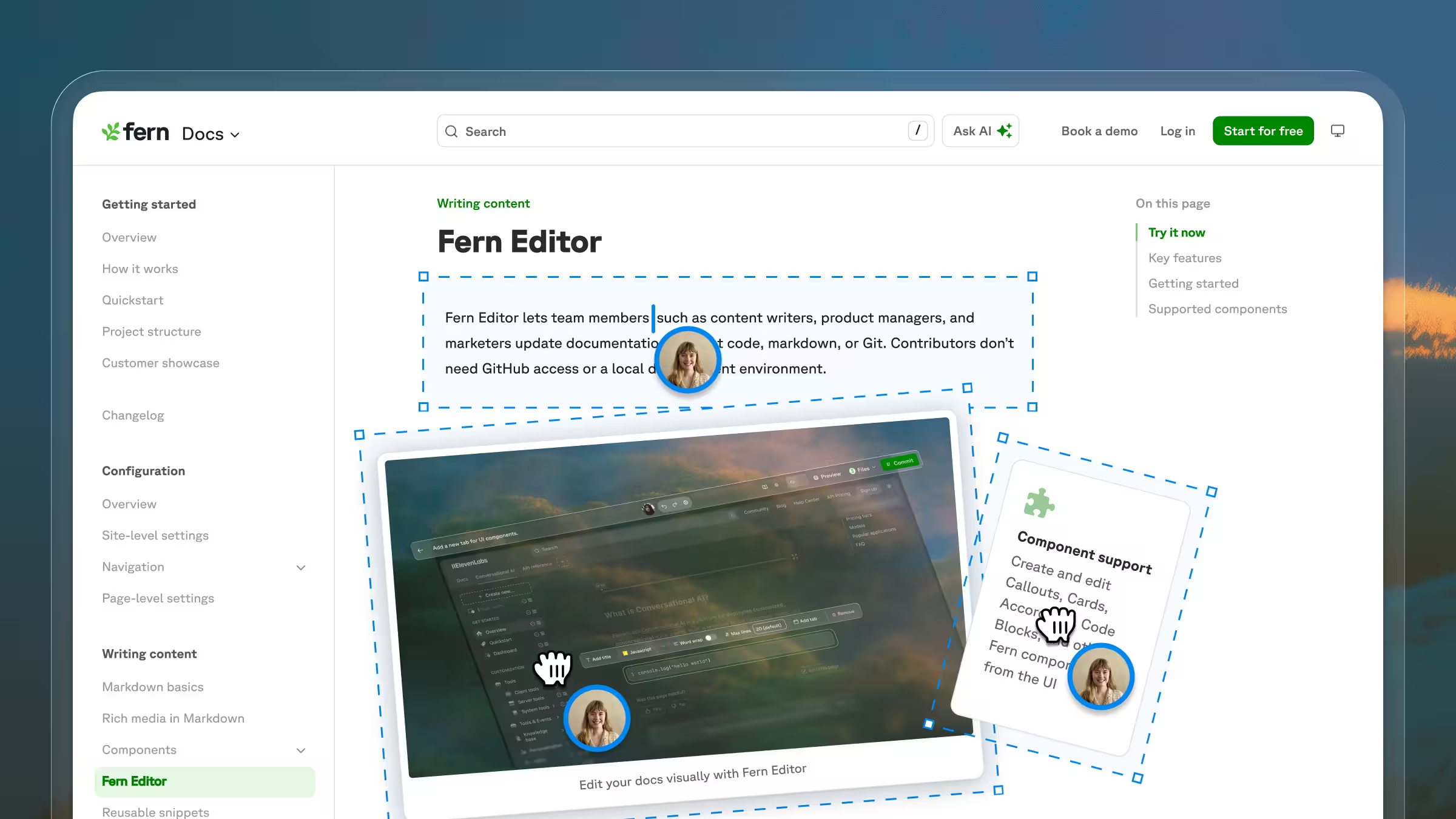
- Fern's visual editor (called the Fern Editor) is version-controlled and mirrors your live site so non-engineers can update docs directly.
- Fern and Mintlify both have embedded AI chat solutions to answer customer questions about your documentation directly on your site.
What is Mintlify?

Mintlify helps software teams publish clear, beautiful technical guides and API references through a docs-as-code model. Authors write Markdown or MDX files that live in their codebase/Git repository, and Mintlify automatically deploys site updates upon git push. They manage the compiler and hosting infrastructure, offering pre-built UI components, search, and analytics without requiring custom frontend engineering.
What is Fern?
Fern is a toolkit for your entire API lifecycle. It accepts a range of API definitions, including OpenAPI, AsyncAPI, OpenRPC, gRPC, and the Fern Definition. From these inputs, it generates idiomatic SDKs and customizable, polished documentation that stays in sync with your code.

Fern generates idiomatic client libraries for TypeScript, Python, Go, Java, C#/.NET, PHP, Ruby, Swift, Rust, and more, directly from your spec. This automation keeps your code snippets, API reference docs, and client libraries in sync with your API spec, removing the drift often found in manual updates.
Fern merges documentation and SDK generation into a single workflow. You define your API once, and Fern outputs an API reference alongside production-ready SDKs. This process follows a docs-as-code model where updates sync automatically on every git push, removing the need to manage separate pipelines for docs and libraries.
SDK generation and documentation in one platform
Mintlify renders static documentation from OpenAPI specs but lacks native support for SDK generators. Teams needing SDKs must depend on separate vendors, splitting the build pipeline. When you update your API definition, you must coordinate changes across these disconnected systems to maintain accuracy.
This separation causes drift between documentation and actual usage:
- Generic request structures in Mintlify references can mismatch functions in externally generated libraries.
- Snippets copied from the documentation can fail because the doc generation tool and SDK generator interpret the spec differently.
Fern treats documentation and SDKs as outputs of a single build process. Pushing an API change regenerates your reference docs and publishes new library versions simultaneously. Since the code snippets in your API reference come directly from the SDKs, they are guaranteed to compile. You avoid the overhead of juggling multiple vendors for a single release.
Self-hosted deployment and enterprise security
Security teams in regulated sectors require absolute control over where documentation lives. Mintlify only offers a hosted cloud service. This model works for early-stage startups but introduces non-negotiable friction for enterprises in fintech, healthcare, or defense adhering to strict data residency protocols. If your compliance framework forbids external hosting, a cloud-only solution becomes a blocker. If enterprise security isn't a requirement for you, Mintlify can do the job.
Fern supports the rigorous demands of enterprise security. Beyond a standard cloud offering, Fern provides self-hosted and single-tenant deployment options. You can run Fern infrastructure within your own virtual private cloud (VPC), keeping sensitive API definitions inside your controlled environment.
This deployment optionality aids SOC 2 and HIPAA verification. For organizations with specific data mandates, self-hosting provides greater control over intellectual property and infrastructure.
Role-based access control and multi-product content management
Mintlify offers authentication at the page level through their dashboard settings, allowing you to choose between full authentication (all pages protected) or partial authentication (mix of public and protected pages). However, this approach lacks the granularity needed for true content-level access control. If you need to gate specific endpoints within an API reference based on a user's tier or role, you're working at the wrong level of abstraction.
Fern provides true content-level RBAC. You can tag specific guides or endpoints to be visible only to certain audiences, such as internal developers or premium enterprise clients. This lets you manage public and private documentation within a single portal. Given that large enterprises manage an average of 1,800 APIs, with only 58% formally documented or cataloged, centralized governance through RBAC prevents APIs from becoming invisible to security teams.
Editor experience and contributor workflows
Mintlify offers a visual editor that renders pages in isolation. Because it separates content from site structure, moving a page or updating the sidebar often forces a contributor to modify a separate configuration file. They must understand the directory tree to make simple changes. This workflow suits engineers but blocks non-technical contributors or those unfamiliar with the site structure.
On the other hand, the Fern Editor mirrors the live site perfectly. The visual interface shows the full navigation bar, footer, and components exactly as a user encounters them. It offers a contextual environment instead of a disconnected text preview.
This structure allows product managers and support agents to fix typos or add guides without fighting complex file structures. By removing the technical abstraction, the entire team owns documentation quality, preventing bottlenecks where only developers managing the repository can push updates.
Both Mintlify's editor and the Fern editor use Git for version control so that changes are easily tracked and can be reversed if needed.
Feature comparison table
Why Teams Migrated to Fern from Mintlify
A voice AI company
- Where Mintlify fell short: They needed documentation and integration support for real-time features, specifically WebSockets and Server-Sent Events (SSE), which Mintlify couldn't offer.
- Why they switched to Fern: Fern supported WebSockets and SSE without workarounds, aligning with their real-time product surface.
An AI search company
- Where Mintlify fell short: They required deeper styling control, a stronger validation pipeline, and better CI/CD visibility. Mintlify lacked the linting capabilities and flexibility they needed.
- Why they switched to Fern: Fern provided a Git-native workflow with stricter validation, more styling flexibility, and SDK generation with broad language support.
A speech AI startup
- Where Mintlify fell short: They needed highly interactive documentation to showcase real-time capabilities in Speech-to-Text and Text-to-Speech. Mintlify couldn't support mic input, audio playback, or SDK-synced snippets.
- Why they switched to Fern: Fern let them embed live mic capture, audio playback, auto-populated API keys, and SDK-generated snippets, so developers could test the product exactly as intended.
An intelligent document processing company
- Where Mintlify fell short: They were managing docs and SDKs across multiple vendors, creating drift and inconsistent updates.
- Why they switched to Fern: Fern unified docs and SDK generation in one system, so updates could propagate cleanly from a single source of truth.
A payments infrastructure company
- Where Mintlify fell short: Their large OpenAPI spec became unwieldy in Mintlify. Endpoint grouping felt arbitrary, the newer playground didn't handle complex demos well, and team management introduced friction.
- Why they switched to Fern: Fern generated a cleaner, more organized reference, offered better grouping, and delivered a stronger Try It playground with prefilled examples that boosted sales demos.
Why Fern is the better choice
Mintlify suits early-stage startups wanting to publish documentation quickly without generated client libraries. It offers a functional workflow for teams with simple requirements and no strict data residency constraints. If you fall into any of those categories, Mintlify can work for you.
Fern bridges the gap between your API definition, documentation, and the client libraries customers use to integrate. It cuts overhead by automating SDK generation alongside documentation to remove the need for separate vendors. Fern supports self-hosting, and its granular access controls meet enterprise security standards that cloud-only tools cannot match. When comparing Mintlify vs Fern, consider your trajectory. If you require consistent SDKs, advanced content governance, and deployment flexibility for a serious API product, Fern provides the correct infrastructure.
Final thoughts on the Mintlify and Fern comparison
The question of is Mintlify better than Fern depends on your current stage and future needs. Mintlify offers a clean, streamlined way to build great-looking documentation, while Fern brings additional capabilities like generated SDKs, self-hosting, and more granular access controls, all within one platform. Your choice should match where your API product is going, not just where it is today.
FAQ
What is the main difference between Fern and Mintlify?
Fern generates documentation, API references and client libraries (SDKs) from your API definition in a single workflow. Mintlify only renders documentation and requires separate tools for SDK generation.
Can I self-host my documentation with these tools?
Fern offers self-hosted and single-tenant deployment options within your own VPC, while Mintlify operates exclusively as a cloud-hosted service.
How does Fern prevent code snippets from breaking in production?
Fern extracts code snippets directly from the generated SDKs, so every example in your documentation is guaranteed to compile and match the actual library functions your users install.
Does Fern support restricting documentation access by user role?
Yes, Fern provides content-level role-based access control that lets you tag specific endpoints or guides to be visible only to certain audiences, such as internal teams or enterprise customers.