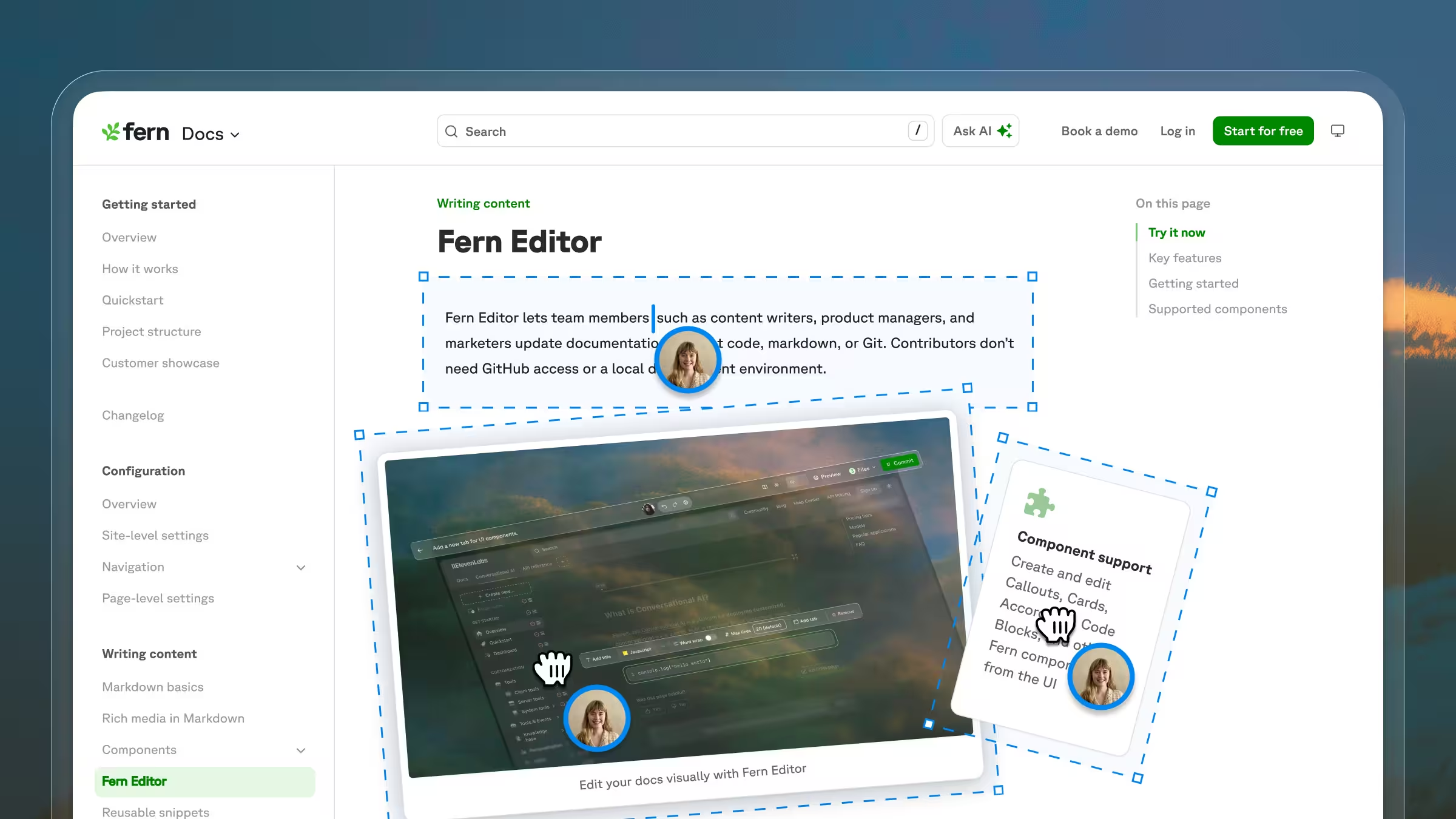

The gap between basic SDK code generation and what enterprise teams actually need is wider than most people realize. Generating client libraries in multiple languages is useful, but it doesn't account for breaking change detection, cross-team governance, documentation drift, security reviews, or the operational overhead when thousands of developers depend on your APIs.
Enterprises need visibility, consistency, and traceability across the entire lifecycle: how SDKs are generated, how they evolve, which changes are safe to ship, and how documentation stays aligned as APIs change. Basic generators can't meet those requirements at enterprise scale.
TLDR:
- OpenAPI generators automate SDK creation, but enterprises need governance, breaking change detection, and compliance features beyond basic code output
- Most tools require separate documentation workflows, creating drift between reference materials and actual SDK behavior
- Fern generates SDKs and API reference docs from the same spec with built-in breaking change detection, automated versioning, and on-prem deployment for regulated industries
- Fern generates idiomatic SDKs in 8+ languages with audience-based filtering, letting you create internal, partner, and public SDK variants from one spec
What is OpenAPI code generation?
OpenAPI code generation parses API specifications, outputting client SDKs and server stubs across multiple programming languages. Rather than manually writing integration code for TypeScript, Python, Java, Go, and other languages, generation tools automate this process from your OpenAPI spec.
For enterprises managing API programs across multiple teams and thousands of developers, basic generation tools produce syntactically correct code, but they often lack the governance frameworks needed for security, compliance, versioning, and long-term maintainability.
Why enterprises need more than basic SDK generation
Enterprises treating APIs as products requires governance frameworks that go beyond simple syntax. Breaking change detection is critical. Checks must run in CI/CD to prevent single API updates from impacting downstream services. Security teams also need visibility into generated code to scan for vulnerabilities, dependencies, and compliance issues before production. Without clear provenance, SDKs become attack vectors that undermine developer trust and increase organizational risk.
Documentation drift adds real cost. When reference docs fall out of sync with SDK behavior, onboarding slows and integration bugs multiply. Discrepancies between OpenAPI specs and backend behavior often go unnoticed until consumers report issues, forcing teams to waste time debugging avoidable problems.
Managing multiple API versions further compounds complexity. Tools must handle v1, v2, and beta releases simultaneously without manual coordination. And for regulated industries like finance and healthcare, audit trails are often required to link spec versions to specific SDK releases and approvals.
What makes an OpenAPI generator enterprise-ready
While individual developers may choose generators based on syntax and language support, enterprise teams need infrastructure that integrates with existing toolchains and scales across departments. Governance must enforce organizational standards—such as naming conventions and authentication patterns—during generation, rather than relying on manual review. The sections below break down the core capabilities that matter most.
Automated publishing
Workflows should push SDKs directly to registries like npm, PyPI, and Maven Central without manual intervention. This removes release bottlenecks and delivers reproducible builds for compliance audits.
CI/CD integration
Generators should run within pipelines (GitHub Actions, GitLab CI, Jenkins), triggering regeneration when specs change and automatically opening pull requests. Pipelines must detect breaking changes—such as removals or type modifications—before merging, allowing teams to review impact and coordinate migrations.
Audience segmentation
Role-based access control allows teams to generate targeted SDK variants for internal teams, partners, and the public from a single API definition. Shared templates maintain consistency for authentication and retry logic, while still allowing teams to override settings for specific product needs.
Auditability and security
Compliance teams need visibility into version lineage to reconstruct historical releases. Enterprise-ready generators must support artifact tracking, externalized secrets, and secure configuration patterns. They must also offer on-prem or VPC deployment options for organizations that cannot send sensitive API definitions to hosted services.
Feature comparison table of OpenAPI code generation platforms
Best overall OpenAPI code generation platform: Fern
Fern is an open-core, enterprise-grade platform that generates idiomatic SDKs and documentation from a single OpenAPI definition. Your API specification becomes the canonical source of truth, eliminating drift between what your API does, what your SDKs expose, and what developers read in your documentation.
When an endpoint changes, Fern regenerates every client library with proper type safety, updates reference documentation automatically, and adjusts code examples across all supported languages.
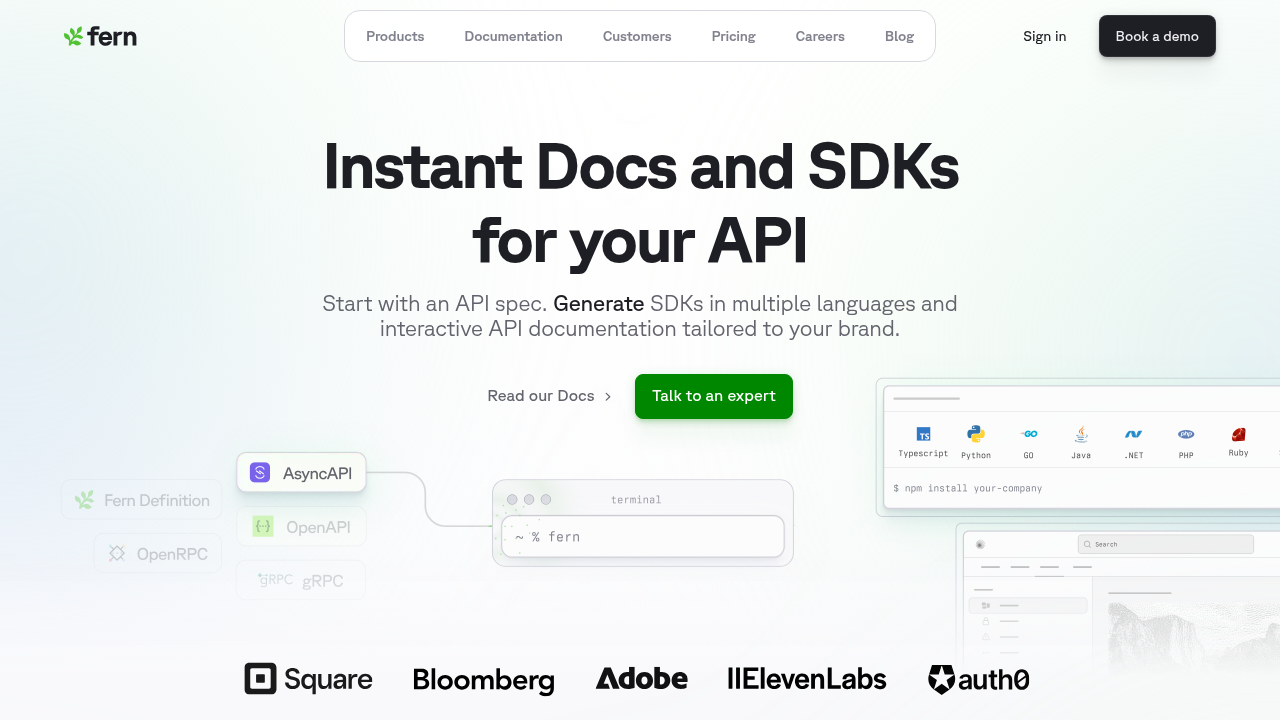
Fern’s open-source generators run locally or inside your own infrastructure, giving security and compliance teams full control over security, compliance, and deployment pipelines. For teams requiring strict VPC isolation or air-gapped environments, documentation can be exported as a Docker container without transmitting API definitions to external services.
Fern enforces governance through automation rather than manual review. It detects breaking changes before merging, applies semantic versioning consistently across SDKs, and supports role-based filtering to create internal, partner, and public SDK variants from a single spec. Authentication, pagination, retries, and streaming support are generated automatically based on language conventions, reducing cross-team overhead and preventing code divergence over time.
Best for: Enterprise API teams treating their API program as a product, requiring governance, compliance, and multi-team coordination.
OpenAPI Generator
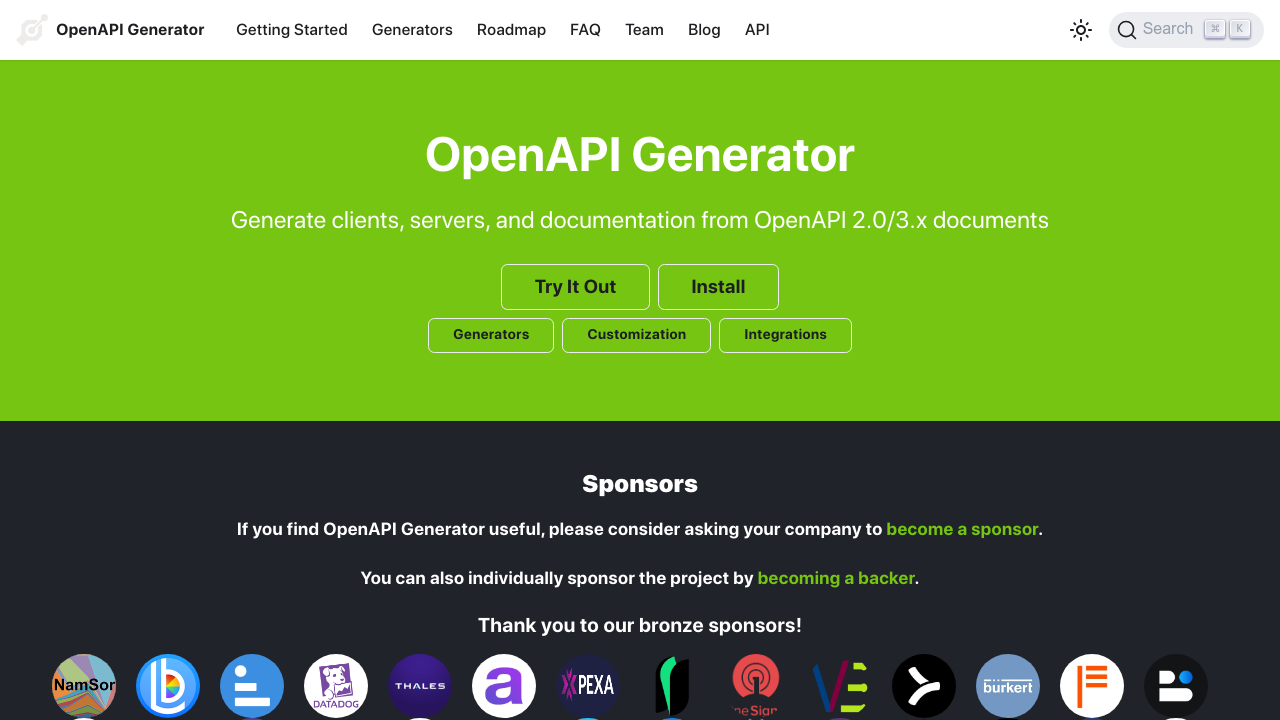
OpenAPI Generator is an open-source tool that generates client libraries and server stubs across 50+ languages from OpenAPI specs. The wide language coverage makes it a practical choice for organizations with varied tech stacks.
The downsides
The generator handles basic code generation but needs custom tooling for production use. Teams must build their own workflow orchestration, testing frameworks, and publishing pipelines. Breaking change detection, versioning logic, and registry deployment all require separate implementation.
The bottom line
This works for organizations with engineering resources to build and maintain the surrounding infrastructure. Teams that need direct control over generation logic and want to avoid third-party dependencies can customize templates and integrate the generator into their workflows.
Good for: Organizations with engineering resources to build custom infrastructure for direct control over generation logic.
Speakeasy
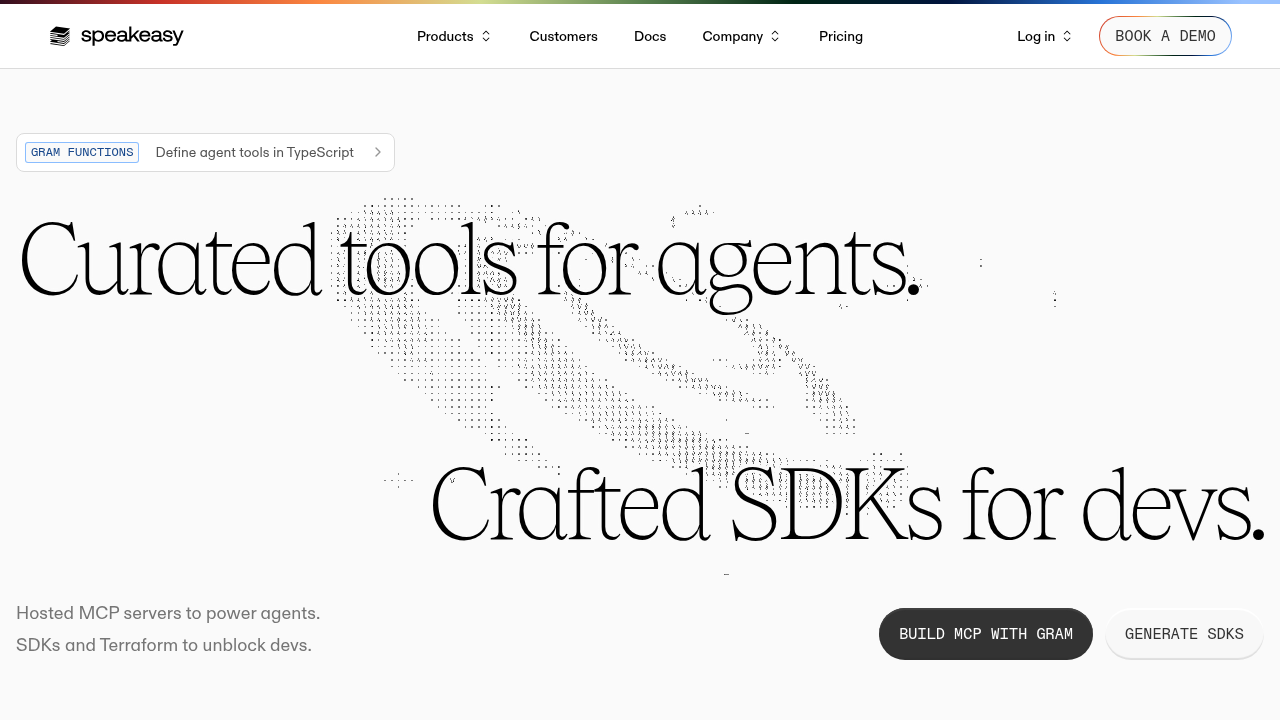
Speakeasy generates SDKs for TypeScript, Python, Go, Java, and C# from OpenAPI specs, with an emphasis on SDK quality and generation velocity. It provides language coverage suitable for many backend and infrastructure teams.
The downsides
Speakeasy doesn't offer a documentation platform, so teams must rely on third-party tools. This creates a risk of drift between reference materials and actual SDK behavior. Notably, language support does not include Swift or Ruby, limiting suitability for organizations with mobile developers or Rails backends. The flattened code organization can also become difficult to manage in large APIs with hundreds of endpoints.
The bottom line
Speakeasy fits teams whose primary need is SDK output in its supported languages and who are comfortable coordinating separate vendors for documentation. The lack of an on-prem deployment option limits its use in regulated industries that require generation behind VPCs or in air-gapped environments.
Good for: Teams focused on SDK generation in their five supported languages who use a separate tool for documentation.
Stainless
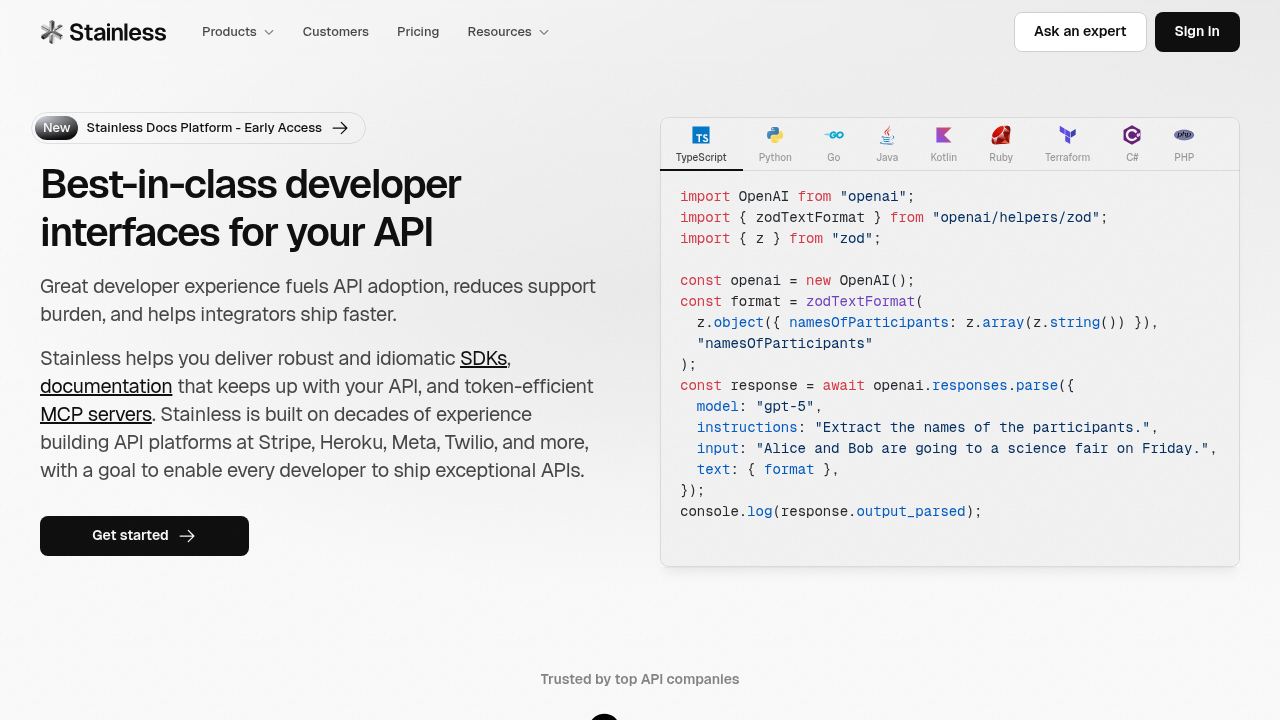
Stainless generates SDKs for TypeScript, Python, Go, Java, and Ruby. Configuration and generation management happen through a dashboard, giving teams a hosted interface for controlling builds and settings.
The downsides
The dashboard-centric workflow makes CI/CD automation harder compared to CLI-driven tools that run directly in pipelines. Language support excludes PHP, C#, and Swift, and generated SDKs handle REST APIs but not WebSocket or gRPC. Documentation generation remains in beta and is not yet production-ready.
The bottom line
Stainless works for teams that want a hosted graphical interface for managing SDK builds. However, the self-serve model provides limited hands-on support, and the lack of an on-prem deployment option makes it unsuitable for organizations that require VPC-based generation or air-gapped environments.
Good for: Teams comfortable with dashboard-based workflows and who don't need production-ready documentation.
APIMatic
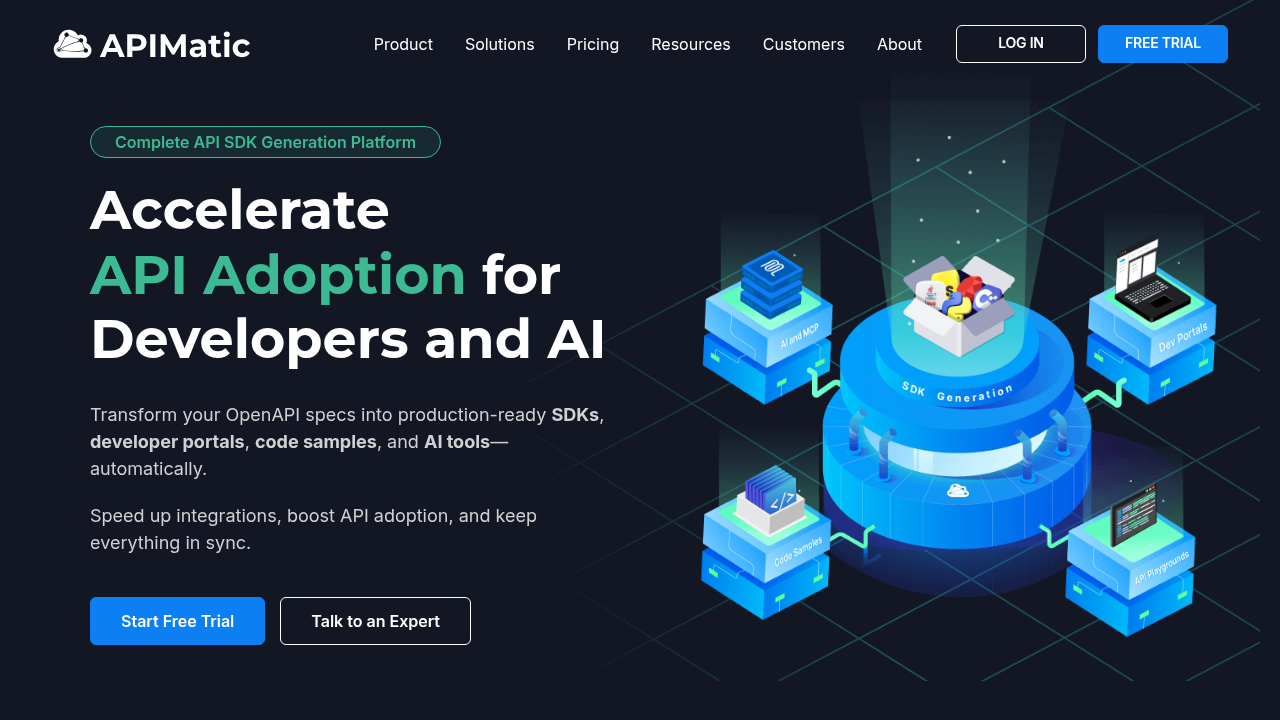
APIMatic is an SDK generation service that has been in the market since 2015. It provides multi-language SDK generation through a portal-based interface where teams upload OpenAPI specs and configure generation settings, making it accessible to organizations that prefer a managed service over CLI tooling. APIMatic supports Java, Python, TypeScript, C# (.NET), PHP, Ruby, and Go.
The downsides
Generated SDKs handle common REST patterns, but lack support for WebSocket connections and streaming protocols. Documentation and SDKs are generated through separate workflows rather than from a single shared spec, which can lead to inconsistencies between reference materials and library behavior as APIs evolve. The portal workflow also requires manual steps for regeneration and publishing rather than automated CI/CD integration.
The bottom-line
APIMatic serves organizations that want a hosted solution for multi-language SDK generation and do not require deep CI/CD integration. Teams relying on event-driven or streaming APIs, or those who care about automated workflows, may find it limiting.
Good for: Organizations preferring vendor-hosted solutions over CLI tooling integrated into pipelines.
Why Fern is the enterprise choice
Teams adopt SDK generators for different reasons, and each tool fits a particular kind of workflow.
Basic generators like OpenAPI Generator are a solid option when you have the engineering bandwidth to build and maintain the surrounding governance, versioning, and publishing infrastructure yourself. Speakeasy and Stainless work when your primary goal is to ship SDKs in their supported languages, and when you're comfortable relying on separate tools for documentation, deployment, or compliance needs. APIMatic fits if you prefer a hosted, portal-based model and don't require deeper CI/CD integration or support for more advanced API patterns.
Fern takes a different approach. It's designed for enterprises that run API programs across many teams and want a consistent, well-governed experience from the spec onward. API reference documentation and SDKs come from the same source, so code examples and client behavior stay aligned as your APIs evolve. Governance features like breaking change detection, audit trails, and on-prem deployment support the security and compliance requirements that matter in highly regulated industries. And with broad coverage across 8+ languages, selective generation for different audiences, and hands-on implementation support, Fern gives large engineering organizations a single workflow for shipping reliable SDKs and stable developer experiences at scale.
Final thoughts on OpenAPI SDK generation at enterprise scale
As API programs expand across teams and languages, the overhead of maintaining SDKs by hand becomes hard to justify. OpenAPI code generation tools help standardize how client libraries are produced, tested, and published, reducing drift and keeping integrations consistent. Open source approaches offer flexibility but require teams to build their own governance, CI/CD automation, and compliance controls, while integrated platforms handle more of that work out of the box.
The right choice comes down to your team's engineering capacity and compliance requirements. For teams that want idiomatic SDKs, strong governance, and a single workflow for both docs and client libraries, Fern provides the most complete developer experience.
FAQ
How do I detect breaking changes in my OpenAPI spec before they reach production?
Use automated breaking change detection in your CI/CD pipeline to compare proposed API changes against the latest version. This flags removals, renames, or type changes before merging, allowing you to review impact across consuming applications and coordinate migrations.
What's the difference between basic code generation and enterprise-ready SDK generation?
Basic generation outputs syntactically correct code, while enterprise-ready generation includes governance frameworks, automated publishing to package registries, breaking change detection, role-based access control, and audit trails for compliance. Enterprise tools integrate with CI/CD pipelines and handle version management across multiple API releases automatically.
Can I generate different SDK variants for internal teams versus public developers from one OpenAPI spec?
Yes, using selective generation with audience tags. This creates filtered SDK variants for internal, partner, and public use cases from a single spec without maintaining separate API definitions or duplicating maintenance work.
Why does documentation drift create problems for enterprise API programs?
When reference docs fall out of sync with SDK behavior, developers copy outdated code examples, integrate using deprecated methods, and file support tickets when integrations fail. This creates expensive support overhead and slows developer onboarding across teams.
When should I consider self-hosting my code generation infrastructure?
Organizations in regulated industries like finance and healthcare need on-prem deployment when API definitions contain proprietary business logic or patient data that cannot transit third-party SaaS services. Self-hosting behind VPCs maintains compliance and protects intellectual property during the generation process.